
About Papa’s Rocket Camp
It all Started with my Dad, a Rocket Kit, and a Beautiful Summer Day …
A football field behind the house, the next Estes catalog in the mailbox, and a grandson who deserves the same thing.
I grew up in St. Clair Shores, Michigan. I was eight or nine years old when my dad got me into model rocketry, and that was that.
I remember starting with starter kits and then graduating to the larger Mercury rocket. I built the Space Shuttle glider, the one that dropped the shuttle to glide in circles and land like the real thing. I built the Scissor Wing rocket, where the wing swings out after burnout, and then the rocket glided to the ground like an airplane. I built countless others, most of them on the kitchen table, most of them a little crooked.
I could hardly wait for the next Estes catalog to show up in our mailbox. I would read the catalog front to back lying in bed and circling the ones that I planned on building. It would take a few weeks of saving enough from my neighborhood grass-cutting jobs and my allowance to buy the next couple of rockets.
The glue would never dry fast enough for me. I would sit there with a freshly built rocket and a fin joint that needed another hour or two to dry. When it finally was ready, I would carry it out to the high-school football field behind our house and put it up. We didn’t have weather radar and the internet back then, so I’d have to rely upon the local weatherman or the darkness of the clouds to determine if today was launch day. Some summers we took them up to my grandparents’ farm and flew them out over the fields, where there was more sky than we knew what to do with. That is where I would launch my multi-stage rockets because a 40-acre field without trees made a great recovery field.
Now … the Next Generation, Enter my Grandson
I wanted my Grandson to have that same feeling — the countdown, the whoosh, the neck-craning hunt for a little orange speck coming back down. But I also wanted him to understand how everything works from build through recovery. So I thought an interactive simulator and a website might be a great way to teach him. It would be a virtual place where he could test things, break things, and play with the concepts before we ever glued a rocket fin.
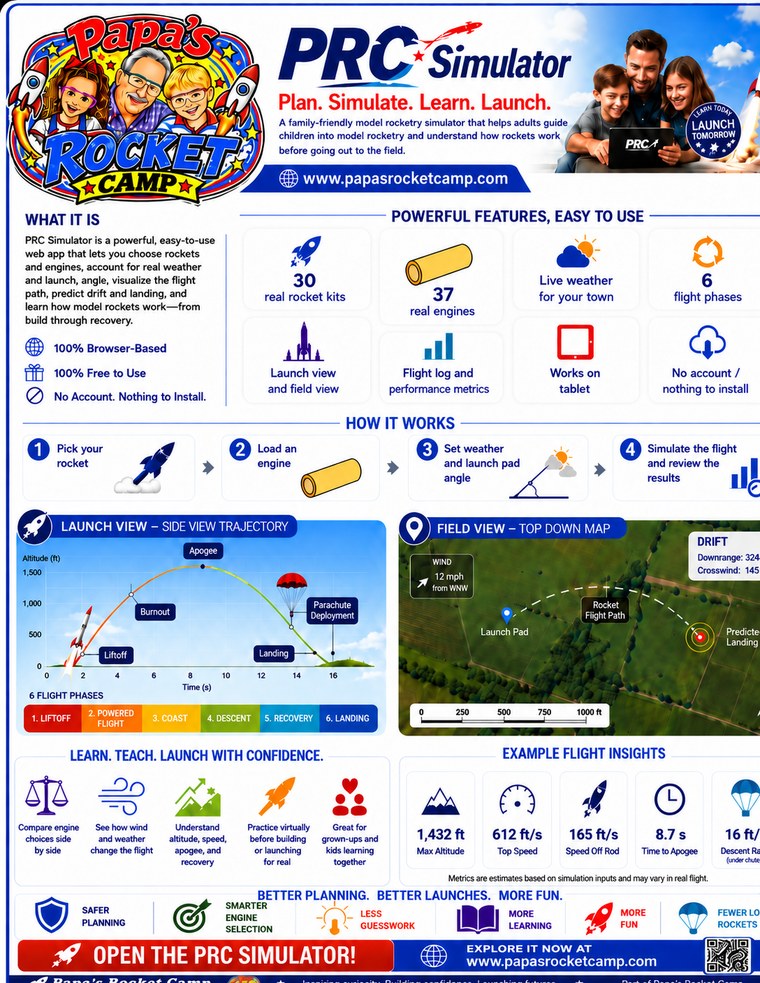
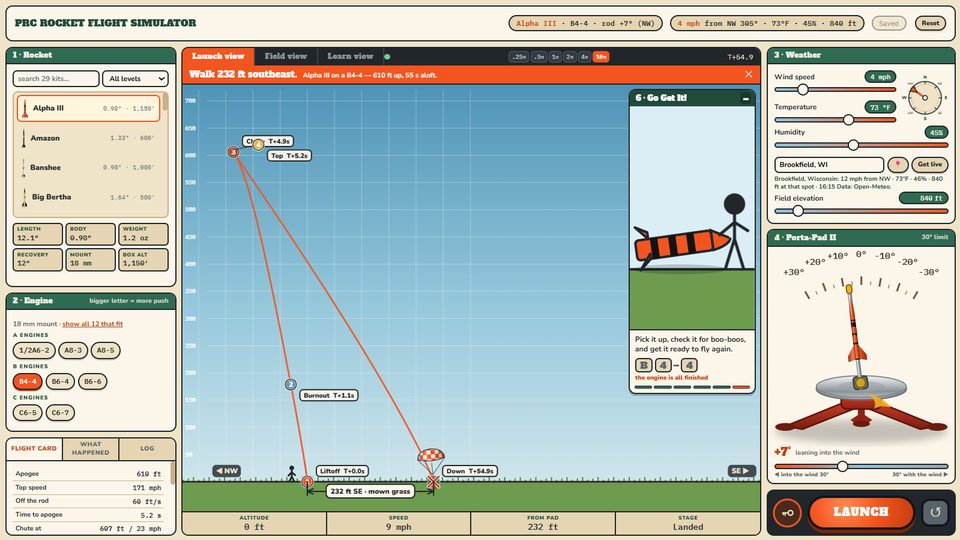
I am an Electrical & Software Engineer with a curious appetite for learning and building things with new technologies. I did quite a bit of research building the simulator, a good deal of it alongside AI, and I believe the aerodynamic/flight model is pretty good. The simulator understands the impact of weather (wind speed, direction, humidity, temperature) conditions, sea-level altitude, Estes rocket aerodynamics (for each specific rocket), Estes rocket engine published thrust curves, launch pad angle, and a host of other variables. The simulator provides an honest estimate, not a promise — but it is a good enough estimate to learn from, and to pick an engine with. We will find out how accurate it is together in early September 2026, when we take a real rocket out and see how close the simulator predicted the landing location.
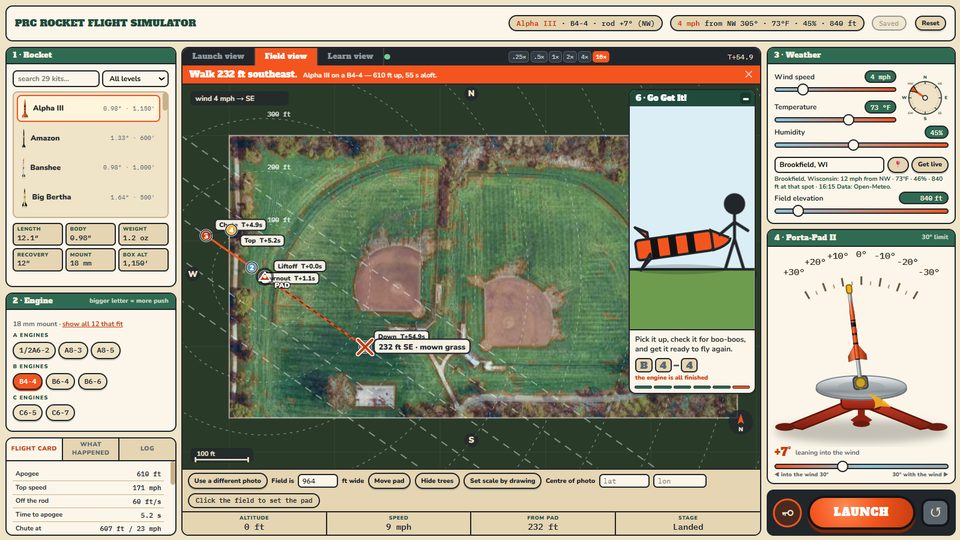
The newest addition to the simulator is the launch field’s satellite map in the Field view. I wanted my Grandson to see where the rocket would come down in our actual launch field, with the real trees and the real fence line, before we walked out there. You can adjust the launch pad location and the simulator will show you where the rocket will land and how far you will have to walk to recover the rocket.
So … Why did I open this up for everyone to use?
I am really proud of how the website and simulator turned out, and it seemed a shame to keep it for ourselves. I decided to open it up for use. The simulator is open to anyone who wants to use it — rocket clubs, schools, Scout troops, or a parent at a kitchen table on a rainy Saturday. If it gets one more kid interested in learning or teaching how these things fly, it was worth it. It is free. However, if you see value, it would be awesome if you could donate a little to help pay for the website fees and new simulator features. Thanks in advance for your support!
This doesn’t replace the real thing…
None of this replaces the experience of building a rocket, scouting out the launch site, or understanding and using the NAR safety code. It is practice for the real thing, not a substitute for it. Read the Safety tab before your first launch day.
I am going to keep improving the model. Please tell me what you think — what is wrong, what is missing, which kit you want added next. There is a Requests tab for exactly that purpose, and I read every one of them. And if you like it and you are able, a donation helps me add features and keep the website paid for.
Enjoy!
— Papa
A Curious Kid at Heart with a Passion for STEM!